

00:00 – Mike Ward: do whatever it takes to win and retain business.
David Tilly: Had a mini flood out the front of my house yesterday afternoon.
Justin Warents: The greener building isn’t necessarily um spelling a lower insurance risk.
Paul Lucas: Hello everyone and welcome to the latest edition of our property insurance power panel. Now catastrophe modeling, inflation and data center risk were a focus last quarter. This session looks at what’s flowing down from the reinsurance renewal and into harder to place property risk along with the
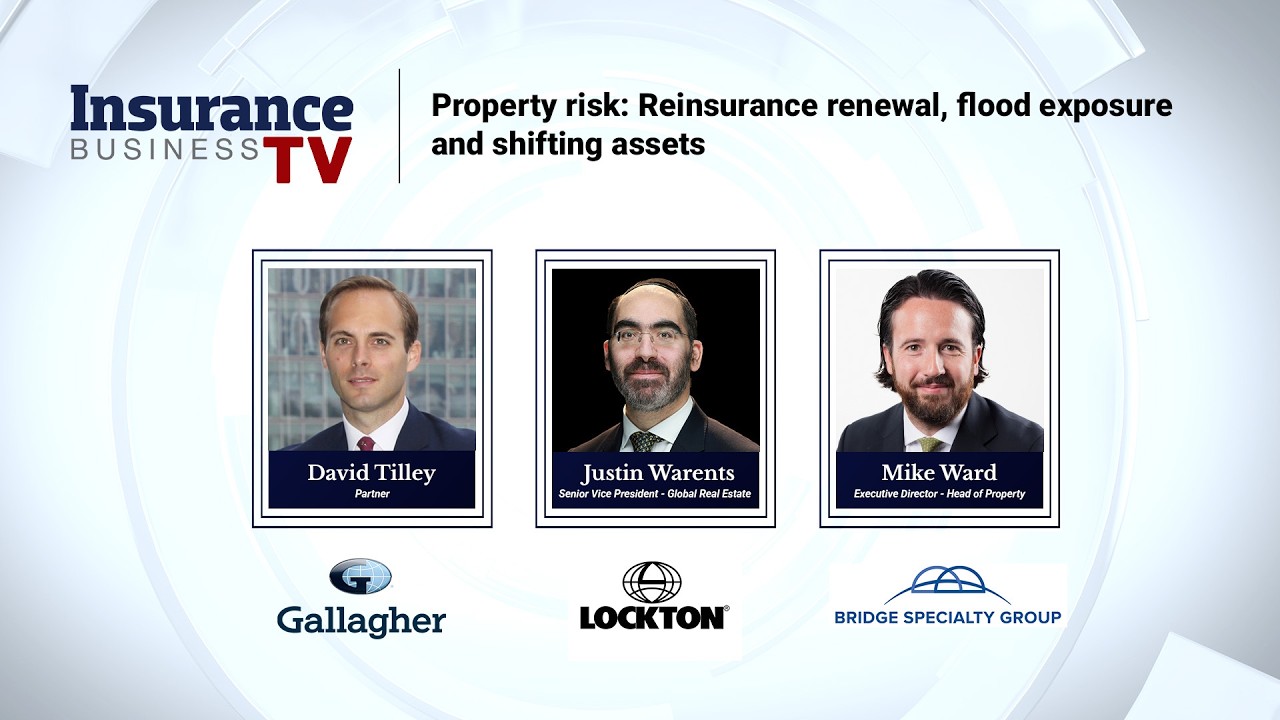
00:28 – Paul Lucas: physical shifts reshaping the asset classes that insurers are covering. And to take us through it, we welcome back Justin Warents, senior vice president, global real estate at Lockton, Mike Ward, executive director, head of property at Bridge Specialty Group, and joining us for the first time, David Tilly, partner in real estate at Gala Specialty. So, welcome all. And to get us started, tell me how are the outcomes of the recent reinsurance renewal feeding through into primary property terms uh capacity as well and pricing of
00:59 – Paul Lucas: course. Uh Mike, what are you seeing?
Mike Ward: Yeah, good morning. So, you know, we are continuing to see the direct soft market uh sorry the direct insurance property market being very soft. There’s significant capacity available with existing insurers remains grow their current portfolios. you know deploy extra capacity if needed but also there is a lot of new entrance into the markets and MGAs which again continues to increase competition across the market you know this is obviously very
01:28 – Mike Ward: valuable for the buyers at the moment with insurers competing aggressively on pricing you know cover enhancements service offerings basically to do whatever it takes to win and retain business but from a reinsurance level you know we are seeing capital positions remain strong um which is obviously supported by a healthy balance sheet. You know, unfortunately, well, not unfortunately, but looking ahead, we see little evidence uh to suggest a meaningful hardening off of the London market and the property market. The only
01:57 – Mike Ward: way this is going to change if there’s a major significant loss or see series of major losses, you know, that particularly impacts insurers and the reinsurers balance sheets.
Paul Lucas: Yeah. And David, from your perspective, do you think reinsurers are willing to concede on rate?
David Tilly: Absolutely. Certainly from the January and the July uh renewals, it certainly seems to be the case still from a very basic economic perspective, we’re in a position where we’ve got an over supply versus uh the demand on there. So very
02:28 – David Tilly: basically that drives the financial contribution on it, but it’s also given clients the opportunity to broaden the terms that they’re receiving, not just focusing purely on price on there. So as we insurers start to concede on pricing and give away some of the coverage, naturally that flows through to the direct market on there. So as Mike was saying, it would need something quite considerable to uh influence the market direction between now and the end of the year on there. So I think from a
02:55 – David Tilly: client perspective, they can expect to enjoy a continued uh buyers market environment and really start to push those uh pricing and the uh and the coverage options available to them. And there and I think that will continue into the uh into the new year as I say unless something significant happens between now and then.
Paul Lucas: Yeah, agree with that just in that that reinsurance tailwind perhaps feeding through into the primary property market.
Justin Warents: Good morning, Paul. Good to be back on. Um yeah, I would agree with those
03:23 – Justin Warents: sentiments. Um certainly we’re seeing the reinsurance tailwind is now generally feeding through into the property uh primary property market. The January renewal, as David said, saw further softening in the property catastrophe reinsurance. We’ve got healthy level of capacity in the primary property market. So very much a uh a soft market uh still remains. However, you know, underwriting uh is not necessarily uh soft. You know, insurers are becoming increasingly sophisticated about what how they deploy their
03:58 – Justin Warents: capacity. So the clients are getting the best outcomes when they can demonstrate that they generally understand their assets. Um, ranging from cat exposure, valuation, construction, defense resilience, and business interruption.
[03:58 – 04:48] Paul Lucas: I don’t know about the rest of you guys, but I’ve certainly been under the caution of some heavy rains lately, and it sort of provokes this question if you want because of course flood and coastal exposure zones have remained a persistent challenge,
04:24 – Paul Lucas: haven’t they? David, from your perspective, what’s the current state of availability and indeed affordability for property in in the particularly high-risk areas?
David Tilly: Uh, yes, I can share that sentiment, Paul. I had a mini flood out the front of my house yesterday afternoon. Um actually some of the uh bits that Justin just mentioned there around the reinsurance market is flowing into certainly into this question and that can be around evidencing your risk profiles to the insurer themselves
04:52 – David Tilly: because this is always an area of the market that is under constant scrutiny on there and I think this can come down to something very basic as the accuracy of your postcode uh on there. I know it sounds silly, but it can be the difference between you being at the bottom of the hill and the top of the hill. And that can really drive an insurer response to what your risk profile looks like. And one of the um areas that certainly we’re seeing insurers looking to do is yes, they want to help in clients on this. And yes,
05:19 – David Tilly: they want to start writing more of your client’s business, but at the same time, they recognize if there’s been an inherent um loss or I guess the program’s been affected by a coastal flood, how do we work with them to uh improve that risk profile? and some of the implementations from a risk management bery. So your help insurers helping with the client cost of improving those resilience certainly is something that we’re seeing creep back into the market now as some of the maybe
05:45 – David Tilly: you might say the softer market behaviors from an insurer perspective on there. So a lot of it comes down to is it available? Yes. Is it affordable? Depends on what your risk profile looks like. So what coverage is available also comes down to what your risk profile is like. So work with your broker, present your risk as clear as possible and be open to maybe implementing and deploying some capex to improve the risk profile of certain assets.
[05:45 – 06:47] Paul Lucas: Yeah. And Justin, do you think this area around flood can be a little bit
06:16 – Paul Lucas: misleading sometimes?
Justin Warents: Yeah, I would say Paul that flow is probably one area where the general soft market that we’ve just spoken about can be uh a little bit misleading. Um there’s certainly more capacity across the property market but where there are the you know the highest flood and coastal exposures then insurers um do remain cautious um that’s not to say that cover cannot be achieved. Um but ultimately the underlying physical risk that remains uh is not going away. Um
06:46 – Justin Warents: so what’s really important is to make sure that um a broker gets well behind uh the position uh because insurers will want to know it’s not about just saying um is does this property sit in a flood zone? It’s you know what is the ground elevation like you know what are the flood defenses in place? What does the drainage look like? Has it had history of flooding? U what resilience measures have been installed? And with all of these uh questions with answers, then that does create an
07:18 – Justin Warents: opportunity to have a conversation with insurers take a view um you know model the flood zone uh properly using latest technology that’s available. So I’d say that good data, engineering information and evidence will certainly help to achieve a meaningful outcome for property owners.
Paul Lucas: Great tips from David and Justin here so far, Mike. But overall, would you say that flood is maybe still one of the more challenging perils in the UK market?
Mike Ward: Yeah, definitely is is evident is one of
07:49 – Mike Ward: the most challenging perils to get there. However, again to reiterate, there is capacity available. Insurers are heavily relying on their flood modeling tools. Um but again, you know, if organizations can demonstrate they’re doing as much as they can to potentially mitigate against a claim happening, you know, by putting in fluff barriers, elevating plant equipment, you know, just basically robust emergency planning, then insurers are willing to come to the table and work with a client to make sure that the cover’s
08:17 – Mike Ward: there in in the event of a claim.
Paul Lucas: Of course, a big discussion point right now is those net zero retrofits and those new green building materials which are changing the risk profile of commercial property. So, uh Justin, how are underwriters adapting to assess that?
Justin Warents: Okay. Well, first thing would we be to make the point that um you know insure the insurance industry is certainly not putting the brakes on when it comes to you know green and net zero. they’re very much in in favor and
08:46 – Justin Warents: recognize that, you know, modern developers are deploying and using that for good reason. But it’s also important to bear in mind that a greener building isn’t necessarily um spelling a lower insurance risk. So typically we’re seeing property owners introduce um things like um you know EV charging which is popular now the use of mass timber the number of buildings that have been developed that that has hybrid use of that um new insulation of facade uh systems all of this works towards net
09:18 – Justin Warents: zero but actually putting on um you know a blue roof or green wall doesn’t necessarily remove the risk. So, it’s really important that the broker works with the property owner to make sure that things like, you know, water damage exposures, the installation, um, who’s designed this, what’s the fire separation, all of these things will contribute to understanding the building better. And I think a really important point here is to make sure that you know from the outset before a property has uh at the
09:51 – Justin Warents: development stage, you know, developers and their professional advisers are taking the time to look at these nuances and testing what it looks like with and without so that they can get a more informed position. because sometimes making a subtle change will not necessarily have a large impact significant impact on an insurance premium and allows the proxy owner developer go along with their strategy. Um whereas for other things um consult consulting with the insurance market means that the risk engineers from the
10:24 – Justin Warents: insurers are able to provide some meaningful input towards things and um they end up getting a better steer on what that property premium would look like once the building has practically confused.
Paul Lucas: Such a good point that that Justin’s made there, isn’t it Mike? I mean greener is not necessarily safer. So from your perspective is there enough data in this area
Mike Ward: at the moment? you know there is there isn’t much long-term data so it is quite limited so that’s why you know we are
10:52 – Mike Ward: seeing insurers you know emphasize the requirement of you know quality of installation fire protections know there’s main procedures and contracts in place for the equipment itself you know again what Justin said there is just because it’s green it doesn’t make it safer or lower risk but again this will come in time when the loss data does come in uh because obviously it’s all fairly new and it’s not It’s not as comprehensive as the older building materials that have been used in the
11:19 – Mike Ward: past. So, it’s still a long way to go until we know the full impact of the, you know, net zero refits and the green building materials, what they’re going to cause to the market.
Paul Lucas: What you’re seeing, David, do you think that insurers actually want to support clients who are making these green steps?
David Tilly: Absolutely. And I think they’ve been vocal for a number of years, being wanting to work with clients, not just from um a global overview, but for their own personal perspective. they want to
11:45 – David Tilly: be partnering with uh clients that are moving into this net zero space. But with that, when you’re tweeting when you’re talking about retrofitting, you’re talking about a building that may have a loss record over the last 10, 15 years that could very well be jeopardized going forward with the introduction of heightened electrical risk, maybe introducing higher fire risk. I think Justin covered it off earlier. So, who are you partnering with from a contractor perspective? And a lot of this comes down to some of the very
12:13 – David Tilly: basics of uh insurance partnerships is don’t tell us when it’s just about to be completed. Get engaged with your broker, get engaged with your insurer, get engaged with the experts when you’re starting to considering this uh move into a retrofit and they will point you in the right direction. So we remove as many surprises as they possibly can be once you get to the PC element of a of a retrofit so you’re comfortable that the insurance is going to be in place what it looks like and of course you might
12:40 – David Tilly: want to make some changes along that development way to improve the insurance coverage and the pricing that might be available to you in general insurers are absolutely on board with working with clients on this. To Mike’s point, unfortunately, we are a data driven industry and until such time as we’ve got a plethora of data on there, there’s still going to be a little nervousness about deploying a huge amount of capacity on there just because we don’t have the numbers to plug into a modeling
13:07 – David Tilly: system.
Paul Lucas: I just want to ask you all about the warehouse and logistics space as well, if I can. Of course, e-commerce growth has driven demand in that space. So Mike, how is that changing the property risk landscape and indeed the underbriding approach that accompanies it?
Mike Ward: Yeah, sure. So, you know, we are seeing obviously the modern warehouses definitely have a larger footprint now. They’re storing more pieces of equipment, more stock, whatever they’re keeping there. And also, you know, a lot
13:35 – Mike Ward: of the modern warehouses do have solar panels on the top as well. So we are seeing insurers focusing more heavily on you know sprinkler protection how the stock or whatever is being there how is that being stored what is being stored and also and also the BI exposure uh you know supply chain dependencies and also the accumulation of the risk around the facility but again you know with tech technology improving we are seeing you know new technologies being implemented um you know real real time
14:07 – Mike Ward: monitoring uh of the building, you know, risk conditions such as, you know, sensors that track factors such as, you know, temperature, mechanical plant performance, when the fire protection systems are in place, you know, it literally generates thousands of data points per hour. So, you know, it’s that is key for property owners to identify potential issues before they actually develop into significant losses, which again is more repeated into insurers to, you know, so they know that the clients on the ball and they’re
14:36 – Mike Ward: doing again as much as they can to stop any claims happening.
Paul Lucas: And David, is there a concentration of risk here in in one area?
David Tilly: Absolutely. I mean maybe not in one area per se but certainly where you get a um a part of Europe, maybe a part of Asia where a lot of uh clients are building in the same general area. What you do start to see is the potential of a wide area event actually causing quite a huge amount of disruption to the to the industry and that can cover all sorts of
15:06 – David Tilly: uh industries like automation um you know last mile logistics on there and as you start to introduce automated robots and systems within the building obviously the fire risk starts to change and develop as that goes along. So I think again a lot of it comes down to engagement with brokers who your tenants going to be. Are you specifically fitting it out for a certain tenant in in which case do they have a history of how they fit that out? Do they have a profile of what they work to or are you literally building a shell and core and
15:37 – David Tilly: then letting your tenant build what however they like to do it fairly I guess un supervised which obviously brings in some different considerations in if you look purely from a concentration of risk perspective and potentially accumulation for one insurer that then comes down to data and potential restrictions in capacity which might be deployed in there and the fact that something like a hail storm across Europe, which we have certainly seen over the last couple of years and some flooding in there can have a much bigger
16:09 – David Tilly: effect than maybe they would have done maybe five, six years ago. But also then you’ve got the knock-on effect of these were maybe once flood planes or grasslands. These are now concrete industrial parks which in themselves have a secondary effect to other buildings and surrounding areas.
Paul Lucas: The Justin, you’re nodding along. It looks like you agree with David.
Justin Warents: Yeah, I would agree with those uh sentiments. Absolutely, Paul. Um, you know, I would say the best way of describing what’s
16:37 – Justin Warents: happening in logistics really is, as you’ve said, concentration of risk. Modern logistics warehouse can look relatively straightforward from the outside. Uh, but actually what’s sitting in in the inside of the building has changed enormously. It’s very complex. they these will there’ll be much greater automation as David alluded to ranging from robotics to sophisticated conveyor systems there’s high density storage and a lot of significant amount of IT infrastructure in in there as well
17:07 – Justin Warents: when you add together um roof mounted solar uh PV batteries EV charging then you you’ve got the potential for loss and it’s just not the cost of rebuilding these warehouses it’s the knock-on effects in the wider supply chain. Uh you know if you’ve got the head office um warehouse for a particular retailer um they’re reliant on that supply chain and if they have damaged that infrastructure that’s going to knock them back. So very loss of very expensive equipment business
17:39 – Justin Warents: interruption and of course the cost of rebuilding. So the thing to do here really is look at what the accumulation is um across several locations because as David had said these could be affected by the same uh perils you know flood storm uh in the environment. So it’s getting ahead of the curve, making sure that there’s good property data like we said before, accurate valuations, uh full uh detailed modeling of the asset and also you know business interaction uh analysis will go a
18:13 – Justin Warents: long way to differentiate one portfolio from the next to make that uh extremely competitive in the insurance market.
Paul Lucas: I just have one final question to throw at you all if I can and that’s just simply to ask what’s changed recently in how large and complex property losses are being handled specifically from a a claims perspective. Uh David, are you seeing any changes?
David Tilly: Well, I think the uh the introduction of technology to these claims responses certainly if I can capture the mood is
18:42 – David Tilly: is improving the speed of response uh to these losses. Um and that can be admittance of liability, understanding the um the cause of the loss and that can be the introduction of drones, um satellite imagery. Once upon a time, you know, just to get that data would have involved a battalion of soldiers getting down to the risk and with that comes time delays and everything else that that contributes towards. So I think in general technology is speeding up the ability to respond positively or negatively whatever way it needs to be
19:16 – David Tilly: from the claim. But we’re also now looking at other areas, not just, oh, the building’s had a fire. What are the knock- on effects of that? How long is it going to take to reinstate this building? We’ve got geopolitical influences across that across supply chains on there. And linking back to what we were saying earlier about retrofitting buildings for you know net zero when they are having losses are clients using this opportunity to potentially change the profile of the asset how they reinstate that. If they
19:44 – David Tilly: are maybe moving and pinching towards a greener building, then actually again does that have an impact on how long it’s going to take to reinstate that building, get the client back to where they were before the loss, but also is it going to have a cost impact and as I say supply chain issues about whether we can get those materials uh in a timely manner to deliver what the clients after.
Paul Lucas: Continuing the claims theme, Justin, are we seeing larger complex claims?
Justin Warents: Yes, Paul. Um we have the generally
20:14 – Justin Warents: the real estate market has is seeing larger losses um coming in you know across you know multiple asset classes. I would say the biggest change really in major property claims have become they’re much more forensic and they’re multi-disciplinary. Uh you know significant property losses today can evolve very quickly and they will involve a lot of a number of parties um working together. So you know David’s right from the perspective of you know using technology but this range
20:45 – Justin Warents: from this ranges from you know loss adjusters engineers um risk surveyors forensic accountants and potentially lawyers and coupled with the insurer and of course the broker there’s quite a you know a number of parties around the table discussing the claim and you know the optimum best outcome for this I think you know looking at mitigation um early on um claim preparedness, uh, modeling what a loss would look like on a portfolio cuz you’re not going to stress that test that, you know, at the
21:19 – Justin Warents: point of a loss, you’re just going to find either that your indemnity period for your business interruption was not long enough or, you know, unfortunately that your reinstatement value was short um, and you’ll have exposure there. So yeah, it’s extremely important for the broker to test all of this with the client. Making sure that major claims can be managed and looked at assessed well before an event happens I would say would be the would be the best thing. You know we buy insurance policy
21:48 – Justin Warents: for a reason and you know for it to respond to claims. So it’s important that that robustness um is there and will ultimately be the test of a quality insurance program.
Paul Lucas: Yeah. Uh Mike, from your perspective, do you think that the insurers, the loss adjusters, everybody across the kind of the value chain when it comes to claims, are they working together a little bit uh smoother now than they were before?
Mike Ward: 100%. Yeah. You know, we’re seeing insurers are actively bringing in
22:16 – Mike Ward: loss adjusters, forensic accountants, you know, even restoration specialists much earlier in in the claims process just to speed everything up. You know there’s definitely a stronger focus on you know business interruptions like supply chain disruption and obviously the challenge of getting the operation back up and running which is you know the most important but you know this has all been sped up again which been echoed here you know the use of drones remote inspections you know d the digital data
22:42 – Mike Ward: collection now is much more fast so you know it’s helping speed up the loss assessments and the resolution but again ultimately what we are hearing what we are seeing is you know obviously prior to use the priorities to make, you know, get claims settled as soon as possible, but also ensures that we want to work with businesses to be able to help them recover as quickly as possible and also obviously emerge more resilient for the future to make sure you know this sort of thing does happen
23:08 – Mike Ward: again that the claims costs remain as low as possible. Um, and you know, obviously the clients want to get back up and running as soon as possible. So, it should work in everyone’s favor really.
Paul Lucas: Great perspectives from everybody. Really interesting discussion. A huge thanks for your time. Remember, of course, that this group will be back together again one more time in 2026. But until then, keep it right here and Insurance Business TV.


