

The US regulator has cleared Elon Musk’s Starmind orbital data centre network through to 2040. The market that insures satellites has well under $1bn of capacity

Putting AI servers into orbit was, until recently, an idea found mostly in investor presentations. This week it got a US government licence.
On Wednesday 25 November the Federal Communications Commission gave SpaceX conditional approval to put up to one million satellites into low Earth orbit for Starmind, its planned network of space-based data centres. The regulator called it the first authorisation in US history for a constellation of data centres in space.
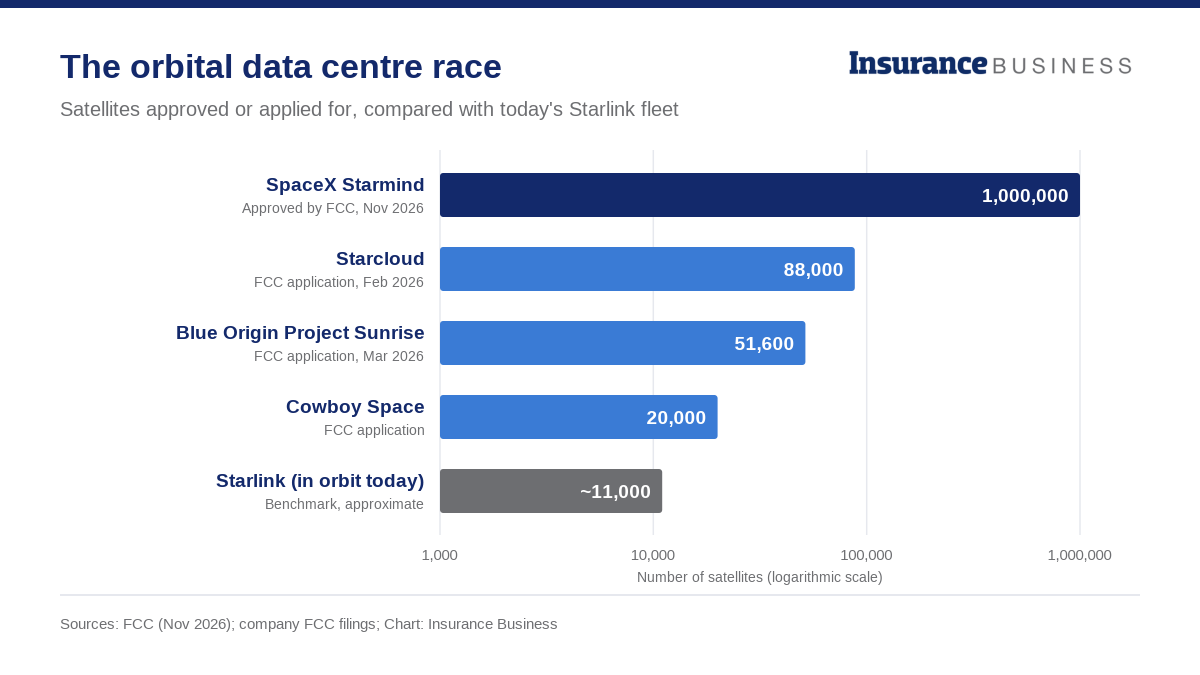
SpaceX’s Starlink broadband fleet, the largest satellite network built so far, has a little over 11,000 spacecraft in orbit. The Starmind licence allows for about 90 times that number.
London provides a large share of the world’s space insurance capacity, and underwriters there are likely to ask a more practical question than how many satellites SpaceX can launch: who will insure them?
What the FCC approved
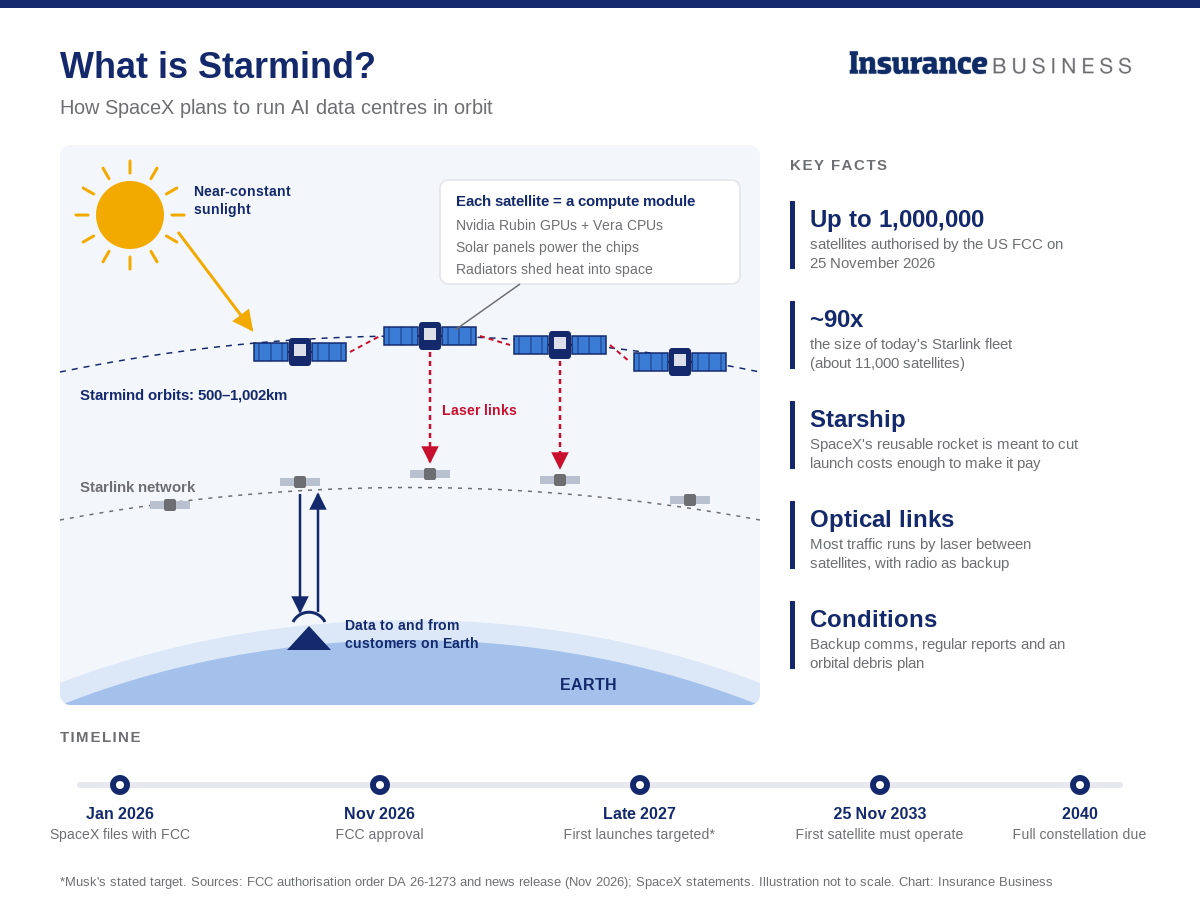
The authorisation order lets SpaceX fly Starmind satellites at altitudes between 500km and 1,002km. The first one has to be up and operating by 25 November 2033 or the licence lapses, and the full constellation is due in place by 2040.
The approval comes with conditions on backup communications, regular progress reports and a detailed plan for limiting orbital debris. Several reports say the debris arrangements for orbits above 600km still need separate approval before SpaceX can deploy satellites there.
The FCC rejected objections from Amazon’s satellite business, Viasat and the American Astronomical Society, which is worried about the effect on astronomy. FCC chairman Brendan Carr said the plan “opens a bold new frontier for the computing infrastructure needed to power America’s leadership and growth”.
Musk has said the first launches could come in late 2027, with numbers building through 2028. In August SpaceX said each satellite would carry Nvidia Rubin GPUs and Vera CPUs. The business case depends on its reusable Starship rocket cutting launch costs sharply.
Read next: AI data centres are becoming too complex for standard insurance
A crowded launchpad
SpaceX is the first company to win approval, but several rivals have applications in. Blue Origin filed in March for up to 51,600 satellites under Project Sunrise. Start-up Starcloud, which flew an Nvidia H100 GPU in orbit in 2025, has asked for as many as 88,000, and Cowboy Space has applied for 20,000.
Google launched a Project Suncatcher prototype on 1 October to test how its TPU chips handle radiation and spaceflight. More satellites are due to fly on Blue Origin’s New Glenn rocket, though not before 2029. The FCC says it is still reviewing the other applications.
Supporters say orbit gets round the problems facing data centres on the ground, where new projects meet local opposition over land, electricity use and water for cooling. A satellite in the right orbit gets almost constant sunlight. Critics point to the engineering challenges, including getting rid of heat in a vacuum, managing space traffic and avoiding debris.
Cost is another hurdle. Wood Mackenzie has estimated that a hypothetical one-gigawatt orbital data centre would cost about $170bn, more than three times a ground-based equivalent, and that launch costs would have to fall by around 70% for it to compete.
A small market facing a big question
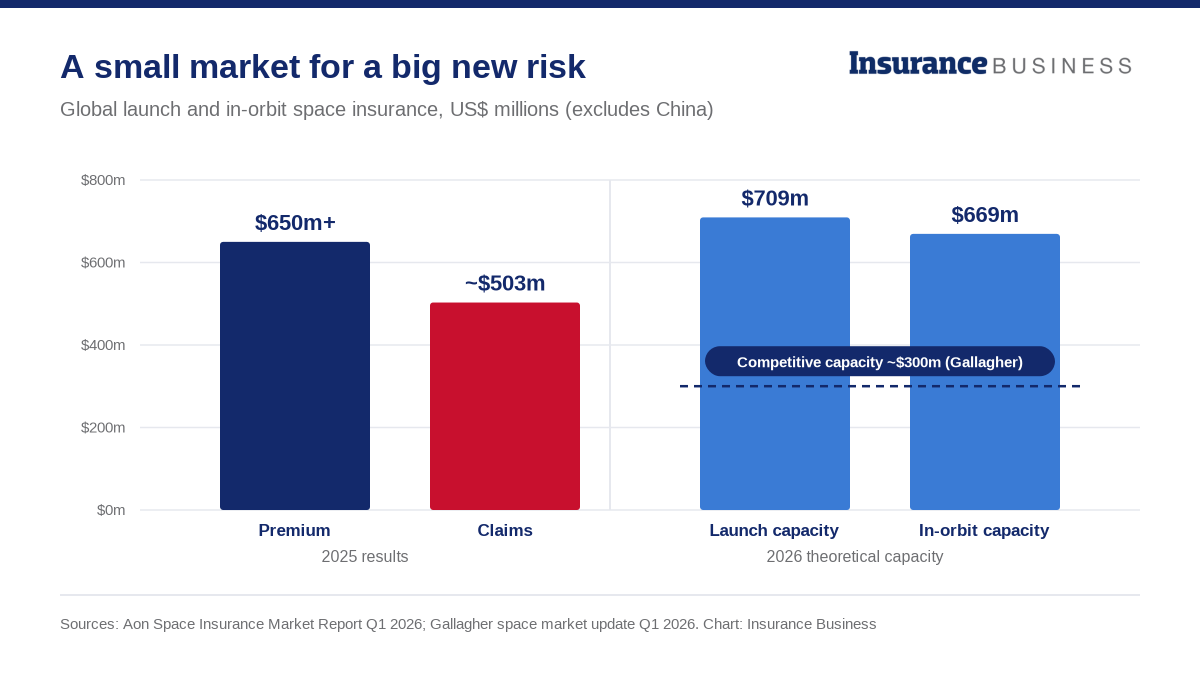
By commercial insurance standards, the launch and in-orbit market is small. According to Aon‘s Q1 2026 space insurance market report, 25 insurers were writing space risk this year, with maximum theoretical capacity of about $709m for launch and $669m for in-orbit cover. Premium income was more than $650m in 2025, against claims of roughly $503m.
Those are theoretical maximums. The capacity underwriters actively compete for is around $300m, and reports have said buyers were still showing little interest in insuring constellations.
Low Earth orbit satellites are relatively cheap and launched in large numbers, so big operators often absorb the loss of a few rather than buy traditional satellite insurance. Andrew Bonwick, vice president of product development at Relm Insurance, told Insurance Business UK in September: “You’re not insuring space businesses, you’re just insuring objects in space.”
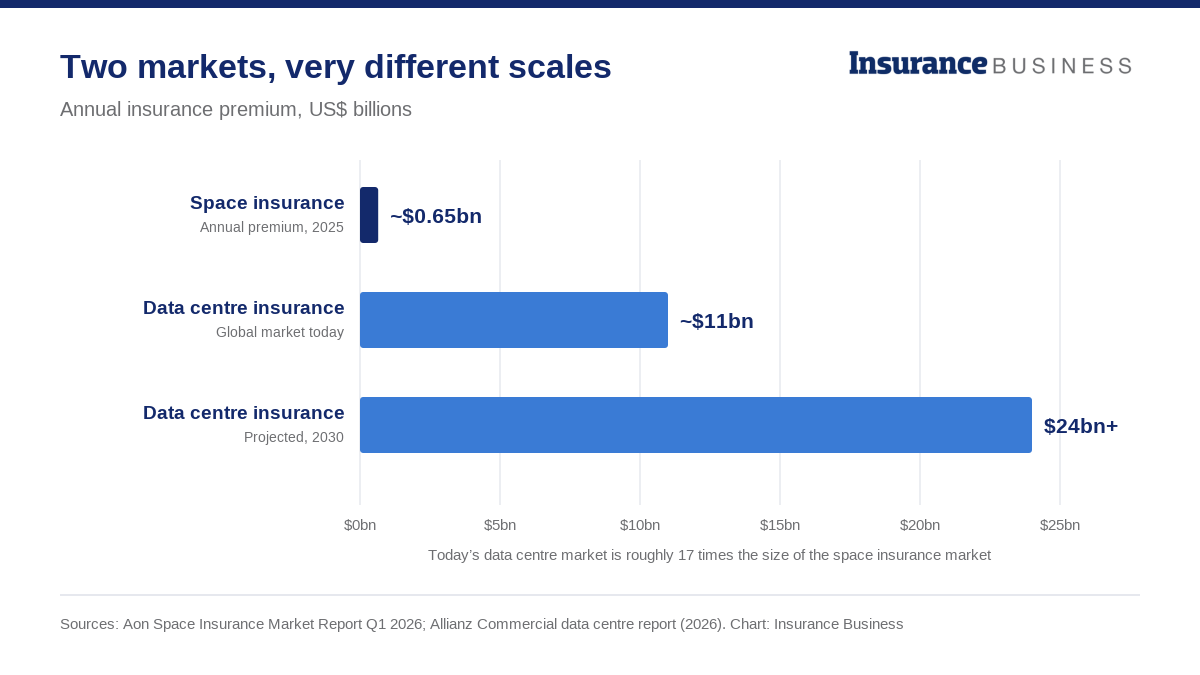
Orbital data centres could change that calculation. A satellite carrying high-end AI chips is worth more than a standard communications satellite, and customers renting its computing power will want to know who pays if it fails. On the ground, data centres are already one of the fastest-growing areas of commercial insurance, with Swiss Re projecting around $90bn of cumulative global premium between 2024 and 2030.
Read next: Space insurance is moving beyond the single satellite model
The risks cut across several specialist lines: launch failure, radiation damage to chips, extreme temperature swings, micrometeorite strikes, collisions with debris, cyber attack, and business interruption for customers whose workloads disappear. There is also third-party liability if a failed satellite damages another operator’s spacecraft.
Debris is the biggest accumulation concern. Bonwick has pointed out that it is hard to prove debris caused a loss when nobody can inspect the satellite. The larger worry is that losses could be correlated. A chain of collisions in a crowded orbit could hit many operators at once, and with total market capacity well under $1bn, even a small fraction of a million-satellite fleet would be a lot to absorb.
Read next: Aon adds $1 billion to data centre insurance program amid AI boom
Why it matters in London
Starmind is licensed in the US, so British rules don’t apply to it. But UK rules are changing at the same time. Orbital licence applications received after 1 December will fall under a new variable liability limit regime, with a default third-party limit of £50m that can be lowered for operators meeting security and sustainability criteria. The same package endorses mutuals and collective sector policies as cheaper ways to meet the requirements.
The government wants cover to be cheaper and easier to buy for British satellite operators, just as the orbits they use look likely to become far more crowded.
For brokers, the first exposure may be on the ground. If orbital computing takes off, ordinary commercial clients could come to depend on it without knowing, as many already rely on satellite navigation and timing. That makes it a contingent business interruption and cyber issue rather than a space placement, and brokers may be dealing with it before the first Starmind satellite is launched.
SpaceX may never launch anything close to a million satellites, as the licence only sets a maximum. But with several companies now seeking approval, insurers will need to decide how they approach orbital computing before the first satellites go up.
Read next: Satellite insurance in freefall as space risks multiply


