

The billionaire who has just left Chelsea is now reportedly shopping his F1 team. The insurance problem behind the sales is one the PRA has spent two years trying to keep out of the UK market

Two months after leaving Stamford Bridge, Mark Walter is reportedly looking for a buyer for another sports asset. This time it is the Cadillac Formula 1 team. And for anyone running a UK life book, the reason behind the sales is worth more attention than the sales themselves.
Sportico reported earlier today that Walter is seeking over $3 billion for Cadillac, with at least seven parties interested. It follows a busy few months. In September, Walter and Todd Boehly sold their combined 25% stake in Chelsea to majority owner Clearlake Capital in a deal valuing the club at £5 billion. Walter had already agreed in August to sell the Los Angeles Lakers for $12.5 billion. In August, his holding company, TWG Global, had denied that the F1 team was for sale even as an insurance probe widened.
The problem across the Atlantic
That probe centres on two US life and annuity carriers Walter controls, Delaware Life and Clear Spring Life and Annuity. Manhattan federal prosecutors and the US Securities and Exchange Commission are examining whether private credit investments recorded as unaffiliated were in fact tied to other Walter businesses. No charges have been filed, and TWG Global denies wrongdoing.
The scale is what caught the market’s eye. AM Best said in July that after a restatement, Delaware Life’s affiliated investments had risen to 42% of invested assets at year-end 2025, up from 3%. The agency moved the outlooks on Walter’s life carriers to negative while affirming their A- ratings. It cited lower risk-adjusted capital and weaknesses in financial reporting controls. The full background is in IB’s coverage of the federal probe into Walter’s insurers.
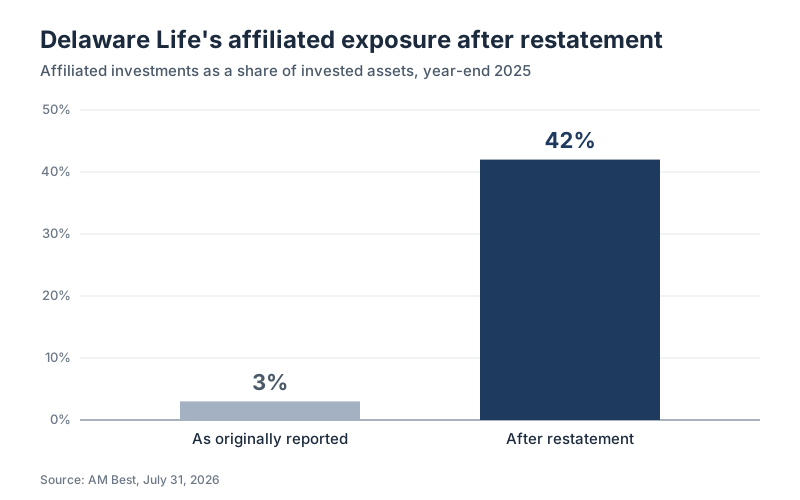
Put simply, policyholder money was supporting the owner’s other ventures to a far greater degree than anyone outside had been told. That is exactly the kind of risk UK regulators have been warning about.
Read next: PRA outlines 2026 priorities, flags closer watch on bulk annuity market
Why it matters in the UK
The Prudential Regulation Authority’s 2026 priorities letter told life insurers to give particular attention to private credit exposures. It cited the Financial Policy Committee’s concerns about how private markets could behave under stress. The letter also stressed robust governance at legal-entity level and careful management of conflicts of interest, particularly under the new capital and ownership structures entering the sector. Conflicts of interest are the heart of the Walter case.

Three of the eleven insurers active in the UK bulk purchase annuity market announced acquisitions by international investors in 2025, consultancy LCP noted, as private capital drove a record wave of UK life M&A.
The PRA’s sharpest move has been on funded reinsurance. In this kind of deal, a UK annuity writer passes both the longevity risk and the backing assets to a reinsurer, often offshore, and holds collateral in return. Under consultation paper CP8/26, published in April, the regulator proposed aligning the capital held against these deals with the treatment of corporate bonds. That would lift the capital held for an average transaction from around 2% to 4% of the liabilities covered to roughly 10%.
The regulator’s worry is partly what is in the collateral, which is increasingly made up of illiquid, private-credit-linked assets. UK exposures to funded reinsurance stand at about £40 billion. The PRA has said they could reach £110 billion over the next decade without intervention. Its 2025 life stress test found that solvency coverage for firms forced to take these deals back onto their books fell by 10 percentage points.
New deals written from October 1 fall under the new approach, although the final rules are still pending. Full implementation is due from July 1, 2027.
Read next: PRA’s funded reinsurance deadline arrives with final rules still pending
Not the same market, but the same questions
None of this means a Walter-style problem is brewing in the UK. The structures differ, and the UK’s matching adjustment regime puts stricter limits on which assets can back annuities. In July, S&P Global Ratings concluded that UK bulk annuity writers’ capital would hold even under severe private credit stress. It also found UK writers are less exposed to middle-market loans than their US peers.
Even so, the US case is shaping the debate on both sides of the Atlantic. Apollo chief executive Marc Rowan, whose Athene business is a major player in funded reinsurance, criticised Delaware’s regulators in September for missing the misclassifications. He warned that “loss of trust comes from regulatory arbitrage.” He has also long been critical of loosely regulated offshore reinsurance hubs, the same concern behind much of the PRA’s thinking on where funded reinsurance collateral sits.
For UK brokers, pension trustees and their advisers, the practical lesson is about asking the right questions. When a buy-in or buyout is priced keenly, it is worth understanding where the backing assets sit, who originated them, and whether anyone on the other side of the trade shares an owner with the insurer. In Delaware Life’s case, regulators did not get a clear answer to that last question until federal subpoenas arrived.
Read next: UK bulk annuity private credit risk remains manageable – S&P


