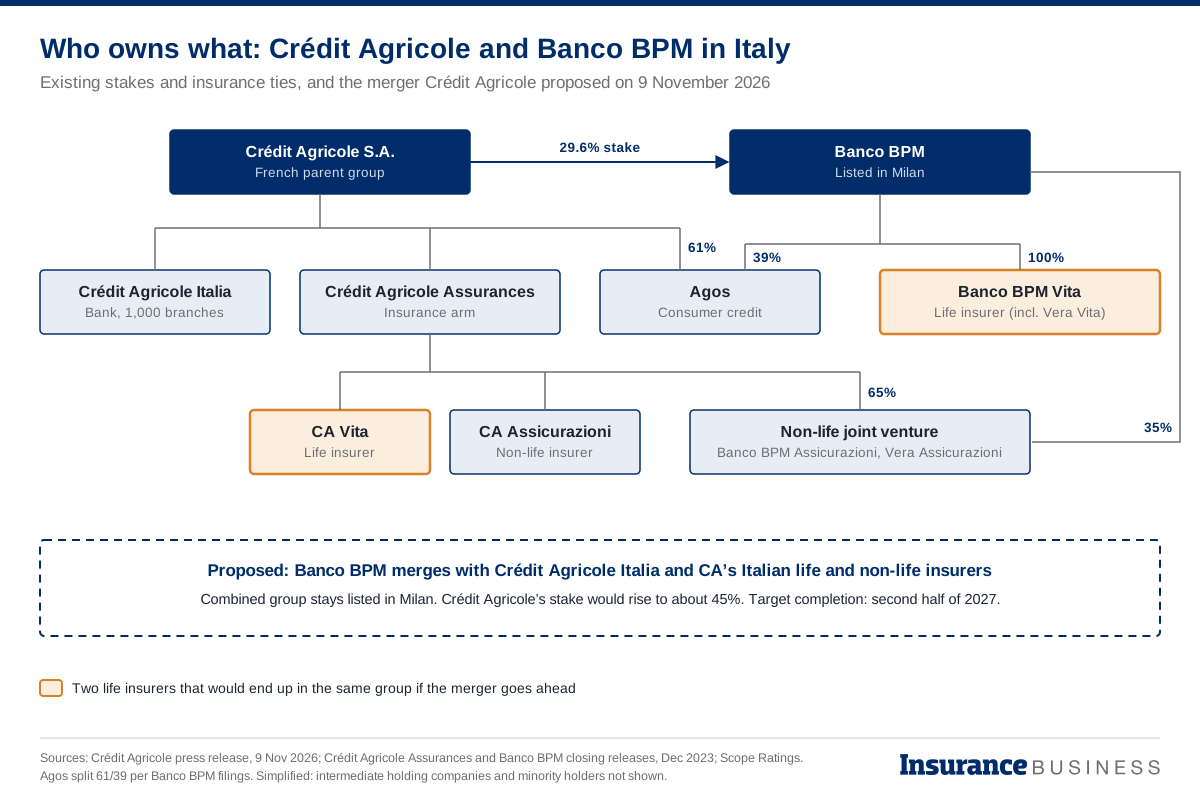
The French group wants to fold its Italian bank and its life and non-life insurers into Banco BPM, creating Italy’s third-largest banking group
Crédit Agricole has finally shown its hand in Italy, and its insurers are part of the package.
The French lender on Monday asked Banco BPM’s board to open talks on merging the Milan-listed bank with Crédit Agricole Italia. Under the proposal, the enlarged group would also take in the French group’s Italian life and non-life insurance businesses, alongside its banking, asset management and specialist finance operations.
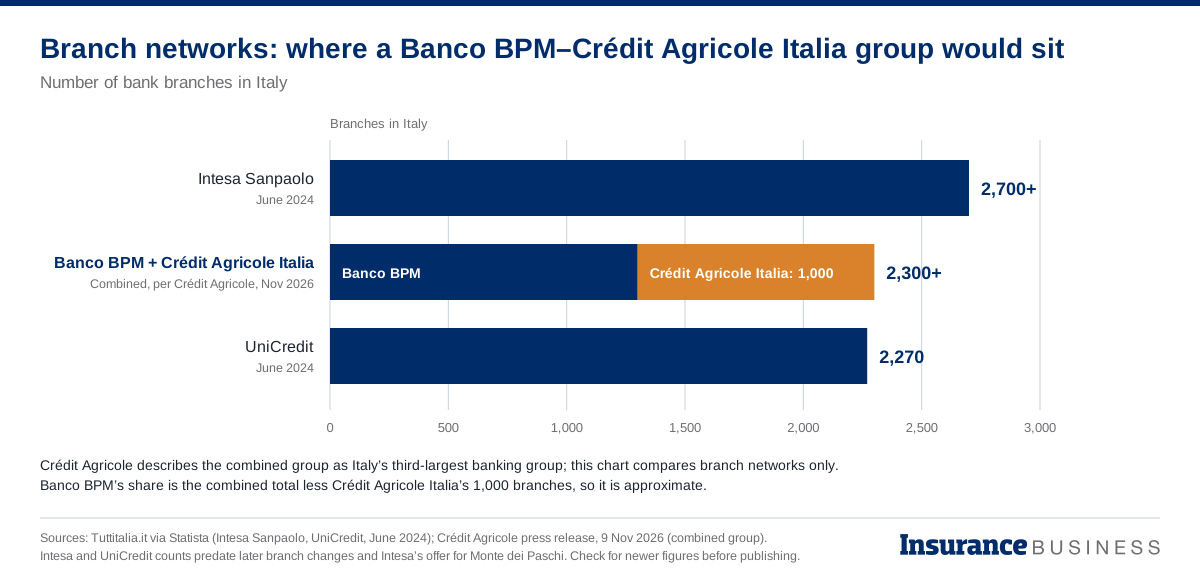
The combined business would serve around 6.5m customers through more than 2,300 branches, making it the country’s third-largest banking group behind Intesa Sanpaolo and UniCredit. It would stay listed in Milan, keep a majority-independent board, and Banco BPM chief executive Giuseppe Castagna would run it.
What’s on the table
Banco BPM shareholders are being offered an exchange ratio that Crédit Agricole says builds in a 20% premium, plus a €1bn special dividend. The French bank puts annual pre-tax synergies at €800m and reckons the deal would lift Banco BPM’s 2027 earnings per share by about 24%.
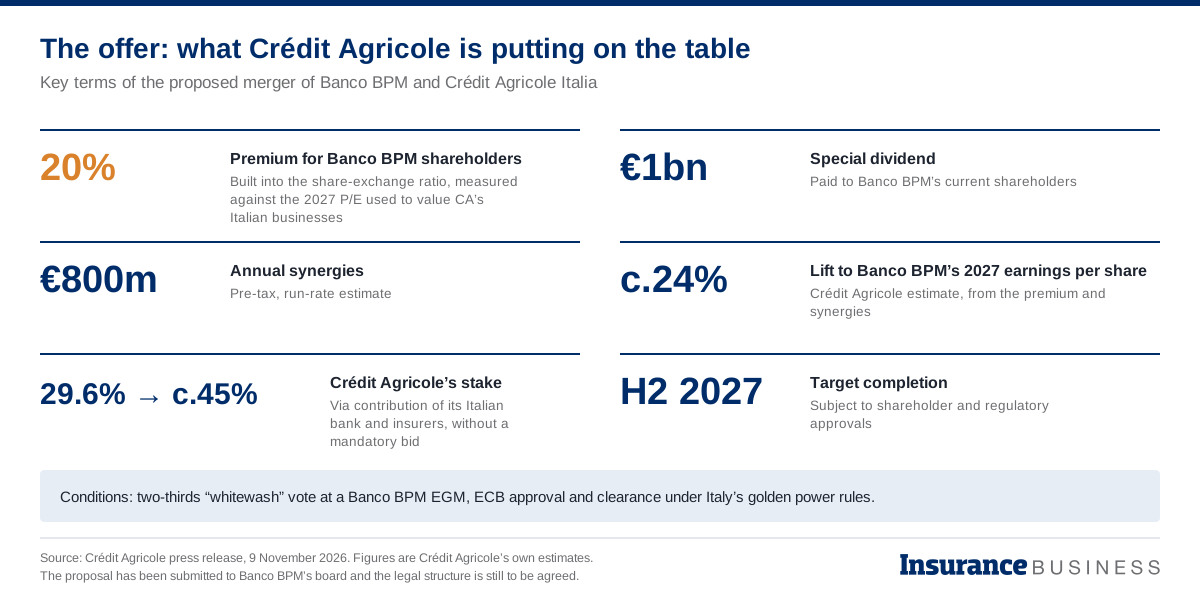
Crédit Agricole, which started buying into Banco BPM in 2022, already owns 29.6% of it. Contributing its Italian businesses would take that to roughly 45%. To get there without triggering a mandatory bid, it needs Banco BPM investors to back a so-called whitewash at an extraordinary general meeting, with at least two-thirds of the capital present voting in favour. Sign-off from the European Central Bank and clearance under Italy’s “golden power” rules on strategic assets are also required. The target completion date is the second half of 2027.
Investors liked what they saw at first: Banco BPM’s shares rose sharply in early Milan trading on Monday.
Read next: Is there a future in bank-insurance deals?
Why insurers should care
The two groups are already joined at the hip in insurance. In December 2023, Crédit Agricole Assurances closed its purchase of 65% of Banco BPM’s non-life carriers, Banco BPM Assicurazioni and Vera Assicurazioni, paying €243.6m and starting a 20-year partnership to sell P&C, personal protection and creditor cover through Banco BPM’s branches. Crédit Agricole Assurances said at the time the deal made it the third-largest non-life bancassurer in Italy.
Life is a different story. Banco BPM chose to keep that in-house, buying out its former partners to take full control of Banco BPM Vita and Vera Vita and build what it called one of Italy’s leading captive life bancassurance groups, as it told investors when the deals closed.
That sets up the big question for the insurance market: what happens to two sizeable life carriers under one roof? Banco BPM Vita, which absorbed sister company Vera Vita this year, wrote more than €4bn of new premiums in 2025 and holds about €18.7bn of reserves including its Irish subsidiary, according to Banco BPM. Crédit Agricole’s own Italian life insurer, CA Vita, collected around €4.2bn in premiums in 2024, according to Italian press reports, selling through Crédit Agricole Italia’s 1,000 branches and through third-party distributors.
Put together, that is a life business writing well over €8bn a year. Deciding which carrier survives, whose investment and reserving approach wins, and what happens to CA Vita’s outside distribution deals will be one of the trickier integration jobs, and a source of uncertainty for staff, distributors and reinsurers until it is settled.
On the non-life side, the deal would tidy things up rather than shake them up. Crédit Agricole already owns more than 60% of both the non-life joint venture and Agos, the pair’s consumer-credit business, a natural feeder for creditor insurance, as Scope Ratings has pointed out. The rating agency also flagged heavy branch overlap in Lombardy, Veneto, Tuscany and Sicily, which points to cost savings but also to closures.
For UK readers, the contrast with home is stark. Bank-owned insurers have largely disappeared from the British market, with Lloyds Banking Group’s Scottish Widows the most notable survivor, as IB has noted. In Italy, bancassurance remains central to how savings and protection are sold, which is why insurance assets keep surfacing in the country’s banking deals.
Read next: Mediobanca launches takeover bid for Banca Generali
A crowded chessboard
The bid lands in one of the busiest stretches of Italian financial M&A in decades, and insurance assets keep turning up at the centre of it.
Banco BPM has been a target or a bidder in almost every round. UniCredit’s offer for it collapsed last year amid friction with the government in Rome. In July Banco BPM abandoned a proposed merger of equals with Monte dei Paschi di Siena after Crédit Agricole made clear it had not been consulted and would not support it, and last month MPS shareholders voted down their own board’s plan to buy Banco BPM.
MPS, meanwhile, is the target of a hostile €30.6bn offer from Intesa Sanpaolo, and its shareholders have rejected management’s plan to fend it off. Much of the interest there is about insurance: through its takeover of Mediobanca, MPS holds roughly 13% of Generali, Italy’s biggest insurer. Intesa has said it would keep that stake, has separately bought around 3% of Generali directly, and has lined up insurer Unipol to take hundreds of MPS branches and merge them with BPER.
Read next: Investor pressure stalls Mediobanca’s Generali deal
The politics
All of this plays out against political sensitivity about foreign ownership of Italian lenders, with Giorgia Meloni’s government facing an election next year. Rome has long wanted a “third pole” to rival Intesa and UniCredit; that plan was dented when Intesa moved on MPS. Crédit Agricole has been careful to stress the new group would be Italian and keep its own identity and autonomy.
Analysts are broadly positive on the strategy but want more detail. RBC Capital Markets’ Anke Reingen was reported as saying the logic stacked up, though the financial impact on Crédit Agricole was still hard to read.
For French banks, the attraction is clear enough. Their home market is dominated by fixed-rate lending that is slow to reprice, and diversifying abroad reduces their exposure to the French economy. For Crédit Agricole Assurances, which describes itself as Europe’s leading bancassurer, a larger and more tightly controlled Italian distribution network would be a valuable prize.
Read next: Generali takeover: which option works?